reported, the Gazeta Wyborcza in its online edition from 24.05 wants the German Bundestag on 9 June to adopt a statement in which have suffered in Germany during the Third Reich officials living Polish associations and Poland, the reprisals are to be rehabilitated. The "Związek Polaków w Niemczech (Association of Poles in Germany) operated until its dissolution in September 1939, more libraries, schools, cultural centers and associations in the Reich. After the forced dissolution of their estates were seized and deported more than 1,200 officials in concentration camps. A statement by the Federal Parliament should not form a basis for any claims for restitution. However, in Bochum is a museum of German Polonia arise, it will set up a representation of the Poles in Germany in the government and each province is the site created a special representative for Poland affairs. Thus, Poland will be treated as a minority in Germany, although, officially, however, will not happen this admission from the German side.
An official of the Polish minority during the prewar period in Berlin was Edward Kmiecik. Kmiecik, born 1915 in Berlin, was after the war, journalist and correspondent for the Polish Radio in Berlin. His father was an important functionary Michał Berlin's Polonia. Edward studied during the Third Reich from the German Academy of Political and was editor of the Polish press in Germany. 1971 was published "Książka i Wiedza" his monograph entitled "Przystanek Berlin" (Berlin bus stop), in his experience, drawing on experience reports and other documents describing. While still a schoolboy he experienced on 10 May, 1933 book burning in Berlin. He describes this way (own translation):
A few years after Hitler came to power was the Berlin University of largely liberal, though of course, some departments and cadres under the strong influence of the Nazis were located. At that time no one had to pass entrance examinations. The high school eligible for study. During the study no one has watched over the students, the students still held by the hand. To be admitted, however, the final exam, you had a certain number of lectures and participation in seminars show. The student himself decided on the way as he gained knowledge. It depends therefore from his inventiveness, and especially from his intelligence as he succeeded to the target. This independent study determined the binding system with colleagues and professors. In this rather loose ensemble of the influence of Nazi student organizations was less than a few years later, when the German universities of the Nazi party line and were subjected to discipline. In the first period after Hitler took power in everyday university life has hardly changed. The old connections and cliques were still continuing. The professors - at least in Berlin - a decision on the direction of the course and content of the lectures rather independently, an exaggerated influence of Nazi officials was not tolerated. Even some Jewish professors were still lectures.
held in this atmosphere, the National Socialists to a shock method. Back in May 1933, a combustion of books and "inferior" literature on the wide, cobbled square in front of the university building and the public library organized. This was a spectacle to medieval type, although performed by contemporary "Germans". The pyre was rightly placed two meters long tree stumps that were transported for the occasion with trucks and acknowledged from the forest in Grunewald brought. The construction of the stake the fire department was present, which should prevent ignite adjacent buildings. To the crowd were even erected barriers to the students and youth, preoccupied by the burning of books, not fall into the fire ...
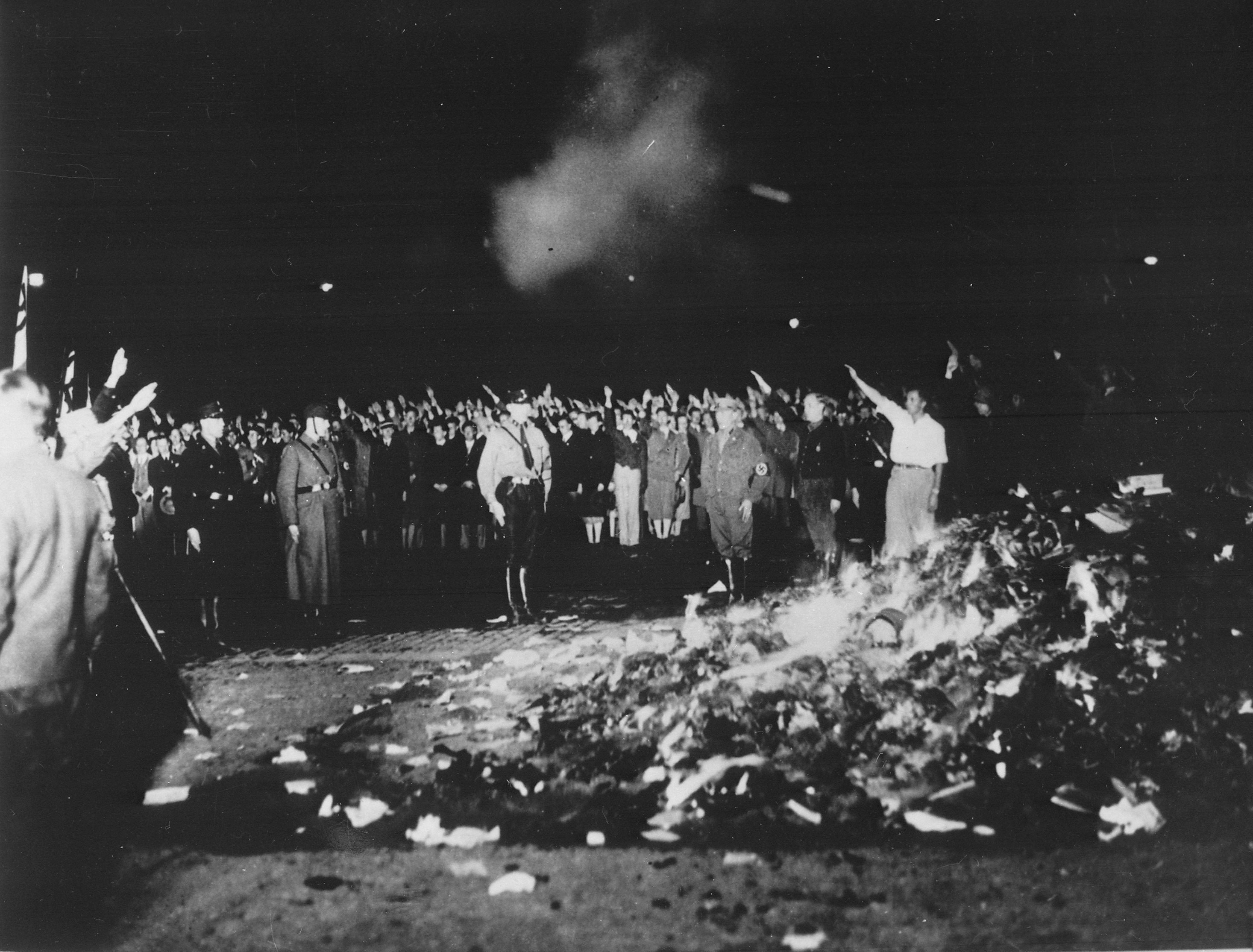
During the dusk - the preparations for this "spontaneous" action lasted all day - kept local Hitler Youth leaders speeches, after which we sang songs, chanted slogans and finally appeared the first books. They were taken in boxes from the public library, which was on the road, but also brought from the nearby university library, to the already burning pyre. The books were removed from the crates and thrown under the shouting and threats in the fire. The empty boxes were collected. There was no spontaneous voids shelves with "foreign literature" instead of, as the press later. The selection has already taken place before. There were only selected volumes, the library could do without, without damage to its own book stock. A copy of the "dirty" literature remained in the Department of banned literature. Meanwhile, the mob raged outside - until late into the night did the Germanic ritual burning of the books of the Community of Heinrich Heine, Thomas and Heinrich Mann, Arnold Zweig, and Sienkiewicz "Quo Vadis".
After this somber event, the climate changed radically at the university. In March 1936, when I was enrolled at the German Institute for Politics, already three students were passes: one for German brown, a blue for foreigners and a yellow for Jews. was


0 comments:
Post a Comment